|
|
|
 |
|
 |
| January
is traditionally about newness: new goals, new year, new start. For
the Solomon Dubnick Gallery, January is about new art and new artists.
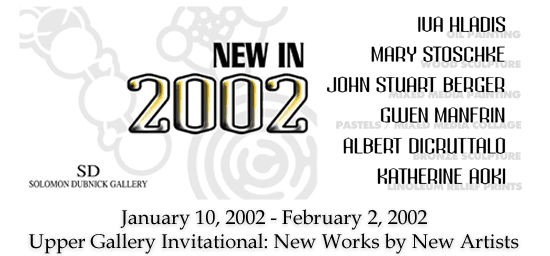
Our “New in 2002” list features six young artists – some of whom may already be familiar – who we would like to formally (re)introduce: |
|
|
| Iva
Hladis was born to a family of painters in the Czech Republic. Her
early works reflect the politically repressive climate of
Czechoslovakia under Russian rule; they are dark and emotional
figurative paintings, telling a story of loss. In 1986, Hladis
relocated to Los Angeles. Her newfound sense of freedom surfaced in
her work--figures became more abstract, symbolism dominated. These
poles of freedom and restraint in Hladis’ work clashed in 1989 with
the fall of communist rule in Czechoslovakia. Introspection upon her
past and future has resulted in her current style, one that places
recognizably human figures in an emotive world where communication
thrives. |
|

|
|
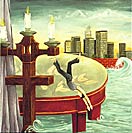
A La Carte'
Oil on Linen, 2000
14" x 14"
|
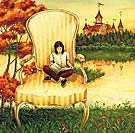
Day Dreaming
Oil on Linen, 2000
14" x 14"
|
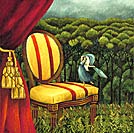
Tree Euphoria
Oil on Linen, 2000
14" x 14"
|
|
|
|
| Katherine
Aoki builds monuments to girlhood. Her hand done linoleum relief
prints attack issues of gender stereotyping and the currently popular
“girl power” reclamation of femininity with a tongue-in-cheek,
humorous approach. In Aoki’s world, we find purple, flowery tractors
and cranes with anime-style women excavating teddy bears from the
ground and building skyscrapers that look like high heels. In other
series of works, women play with huge power tools, or appear as
superheroes in crisis situations, their super-strength determined by
their learned vocational skill. |
|
|
|
|
|
|
| Works
by Albert Dicruttalo are introspective, psychological, poignant
reflections on spirituality, humanity—on the process of
self-definition and achieving clarity. Combining cast and fabricated
bronze, sometimes accenting with touches of steel, Dicruttalo employs
all the tricks of his medium to explore all the tricks of human
reality. There is a double beauty in the choice of bronze: the
coldness that we naturally associate with metal is reflective of
Dicruttalo’s deeply psychological, no-holds-barred probe into the
human psyche, while the malleable and changeling qualities of metal
mirror the process of human growth and the organics of
biology. |
|
|
|
|
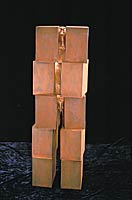
Deconstructed Male
Corten steel and
cast bronze, 2001
72" x 23" x 16" |
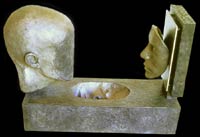
Identity Crisis
Bronze, 2000
16" x 12" x 12" |
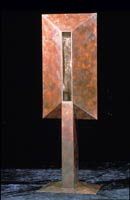
Passage
Bronze, 2001
72" x 22" x 12" |
|
|
| |
| Armed
with irony, cynicism and dark humor, John Stuart Berger attacks
the foundations of convenience culture, excess and human interference
in the process of nature. His current body of work often uses birds in
analogous posturing of family dysfunction, rampant consumption and the
“all-in-the-name-of-profit” attitudes of the capitalistic world.
Berger treats his viewers to bold colors, ferocious birds with saw
blade teeth and the magical parallel universe of fast food where
chicken nuggets come from Canola Island and corndogs have the faces of
killers. |
|
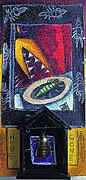
Here and Gone
Mixed Media, 2001
14" x 7"
|
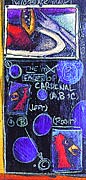
The Three Heads
of a Cardinal
Mixed Media, 2001
14" x 7"
|
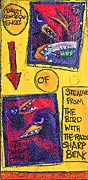
The Bird with the Razor Sharp Beak
Mixed Media, 2001
14" x 7"
|
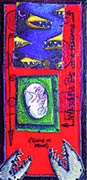
The Watchful Eye
of a Predator
Mixed Media, 2001
14" x 7"
|
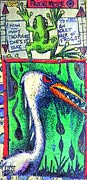
Frogometer
Mixed Media, 2001
14" x 7"
 |
|
|
|
| Gwen
Manfrin uses
imagery as a tool to examine the relationships between things. Whether
with word and collage that describe the pleasures of youth, or realist
pastels that combine a specific series of forms or shapes, Manfrin
creates narratives for her viewers to discover. Her aesthetic ideal
lies in the richness of color, texture and composition. Manfrin
renders objects literally, her shallow picture plane divided into a
specific order, thereby imparting a sense of importance that the
audience is encouraged to interpret and define. |
|
|
|
|
|
|
| Mary
Stoschke
fashions her narratives from wood. With bright pink rabbits and black
cats as characters in the scene, Stoschke creates a tense interplay
between male and female sexual stereotypes and politics, especially
those that haunt the process of adolescent development. At first campy
and funny, the closer look at the female cat tattooed with “hoochie,
trollop, toy, etc.,” and the triumphant male rabbit smoking his
cigarette makes a lasting impression upon the viewer, recalling all
the scars of sexual self-discovery suffered on the way to becoming an
empowered individual. |
|
|


|


